
Introduction: Why Audits Are Your Secret Weapon
If you’re knee-deep in ISO 27001:2022, you already know: internal audits aren’t about compliance paperwork. They’re your frontline defense against breaches, your culture-building tool, and your shortcut to stakeholder trust.
But let’s be real:
- Audits can feel daunting (especially if your team sees them as a “witch hunt”).
- The 2022 update added new controls (hello, threat intelligence and cloud security!).
- No one wants to waste time on box-ticking exercises.
This guide fixes that. I’ll walk you through a practical approach to ISO 27001:2022 internal audits—no jargon, no scare tactics. Just actionable steps to build a truly resilient ISMS.
(Quick note: Replace “ISMS” with “information security system” if your team hates acronyms!)
Step 1: Prep Work – Setting the Stage for Success
Mistake to Avoid: Jumping straight into audits without alignment.
Your 3-Part Prep Kit
- Scope Your Audit
Ask: “What’s most critical RIGHT NOW?” (e.g., new remote work risks, cloud data flows, third-party vendors).
Template:
| Audit Scope: | [Department/Process] |
| Focus Areas: | [e.g., Access Controls, Incident Response] Exclusions: |
| Exclusions: | [e.g., Legacy systems being phased out] |
2. Build Your Dream Audit Team
- Skills needed: ISO 27001 knowledge + emotional intelligence (they’ll interview stressed staff!).
- Tip: Rotate auditors yearly to keep perspectives fresh.
3. Gather Documents (The Smart Way)
- Must-haves: Risk assessments, incident logs, training records, supplier contracts.
- Secret Weapon: Pre-audit checklist (Download a free template here).
💡 Human Touch: Run a 30-minute “kickoff chat” with department heads. Frame it as: “Help us protect YOUR team’s work.”
Step 2: Conducting the Audit – Listen, Don’t Interrogate
🔍 Reality Check: If staff clam up, you’ll miss critical insights.
The Art of the Interview
- Do:
o “Show me how you handle an access request.” (Observe the actual process.)
o “What’s the ONE security task that slows you down?” (Reveals process gaps.)
- Avoid:
o “Did you follow Procedure 4.2?” (Triggers defensive mode.)
Document Review: Beyond Box-Ticking
- Check for:
o Alignment: Does the BYOD policy match reality?
o Evidence: Are backup tests logged? Is phishing training completed?
- Focus on NEW 2022 Controls:
o Threat intelligence (A.5.7)
o Cloud security (A.5.23)
o Data masking (A.8.11)
Finding Non-Conformities (Without Blame)
| Severity | Example | How to Phrase It |
|---|---|---|
| Major | Unencrypted customer DB | “Let’s prioritize encrypting the customer DB—this reduces breach risk by 70%.” |
| Minor | Outdated incident form | “Updating this form will help IT respond faster!” |
🌟 Pro Tip: Snap photos of “good practices” to share company-wide. Positive reinforcement > punishment.
Step 3: Reporting – Clear, Actionable & Kind
📊 Bad Report: “Non-conformity found in A.8.1. HR failed policy.”
✅ Good Report:
Opportunity in HR Onboarding:
- What we found: New hires get system access before security training.
- Risk: Untrained staff = phishing vulnerability.
- Fix: Align training with Day 1 access (owner: Jane, deadline: Aug 30).
- Kudos: HR’s updated contract templates rock!
3-Part Report Structure
- Executive Summary (1 page max for leadership).
- Findings Table (Include risk ratings: High/Medium/Low).
- Root Causes (e.g., “Training not mandatory,” not “HR messed up”).
Step 4: Follow-Up – Where Audits Turn into Action
🚨 Truth: 80% of audit value dies here if fixes aren’t tracked.
Your Action Plan
- Assign Owners
o Not: “IT will handle it.” → Yes: “Priya (IT Lead) to update firewall rules by 9/1.” - Track Progress
o Use a shared Trello/Excel tracker (Grab our free version). - Verify Fixes
o Re-check high-risk items in 30 days.
⚡ Culture Hack: Celebrate “Fix of the Month” with coffee vouchers. Visibility drives accountability.
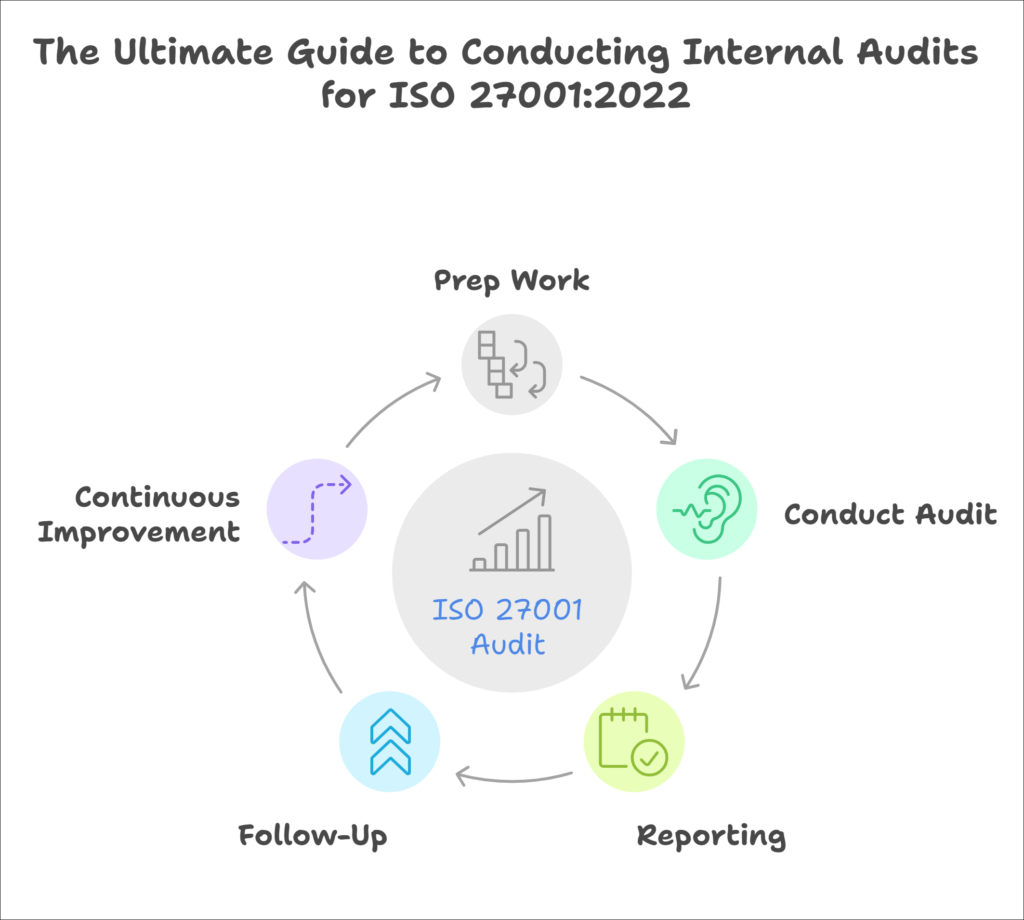
Step 5: Continuous Improvement – Make Security a Habit
🔁 ISO 27001 isn’t a “certificate on the wall.” It’s a living system.
- Annual Tune-Ups:
o Fold in lessons from incidents (e.g., “After the Q3 ransomware scare, let’s enhance backup checks”). - Surprise Mini-Audits:
o 2-hour “flash audits” on high-risk areas (keeps teams alert). - Turn Data into Stories:
o “Last year’s access control fix saved us 200 hours of breach cleanup!”
Conclusion: Audits = Trust, Not Fear
Internal audits aren’t about catching failures—they’re about building resilient, confident teams. When you:
- Frame audits as collaborative (“Help us protect you”),
- Celebrate quick wins (even small fixes!),
- Share lessons transparently,
…you transform compliance from a chore into your competitive edge.
Your next step: Pick ONE section from this guide to implement this month. Start small. Build momentum.