
The Relationship Between ISO 27001:2022 and ISO 9001:2015
Understanding the integration between information security and quality management
Introduction
In today’s fast-paced digital landscape, organizations face increasing scrutiny regarding how they manage information and ensure quality. Two critical standards that help organizations demonstrate their commitment to these areas are ISO 27001:2022 and ISO 9001:2015.

While they serve different primary purposes—information security and quality management, respectively—understanding the relationship between these standards can lead to enhanced operational efficiency and organizational resilience.
This article delves into how ISO 27001:2022 and ISO 9001:2015 are interconnected, exploring their key similarities, differences, and the benefits of integrating the two systems.
Understanding ISO 27001:2022 and ISO 9001:2015
ISO 27001:2022
ISO 27001:2022 is an international standard focused on establishing, implementing, maintaining, and continually improving an Information Security Management System (ISMS). It provides a framework for managing sensitive information so that it remains safe and secure.
Key Components:
- Risk Assessment and Treatment: Identifying and evaluating risks to information security and determining appropriate controls.
- Leadership and Commitment: Engaging top management in promoting information security.
- Continual Improvement: Regularly reviewing and updating the ISMS to adapt to changing conditions.
- Compliance: Ensuring adherence to relevant legal and regulatory requirements.
ISO 9001:2015
ISO 9001:2015, on the other hand, is a quality management standard that focuses on meeting customer expectations and delivering customer satisfaction. It is applicable to any organization, regardless of its size or industry.
Core Principles:
- Customer Focus: Prioritizing customer satisfaction as a fundamental goal.
- Leadership: Establishing a clear direction and purpose for the organization.
- Engagement of People: Valuing employee involvement for better operations.
- Process Approach: Understanding and managing interrelated processes for effective outcomes.
Key Relationship Aspects
1. Common Objectives
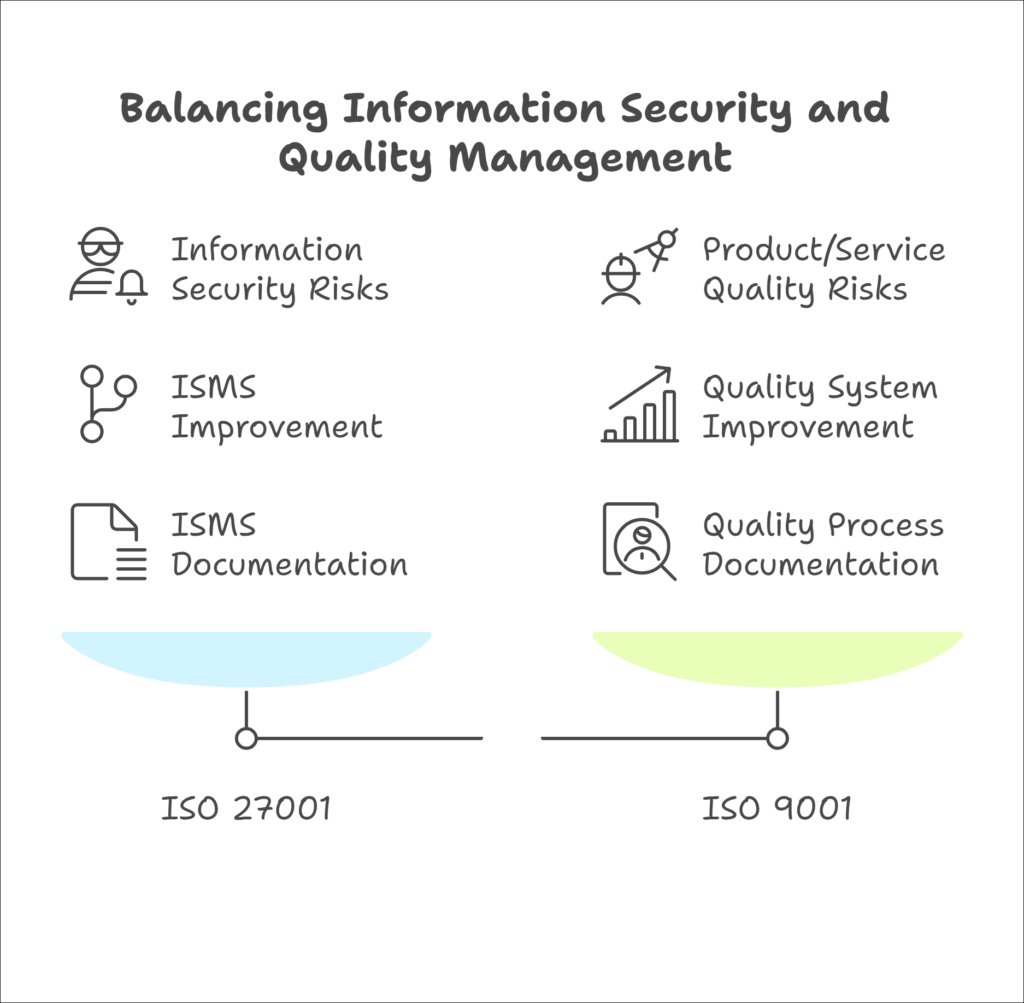
Both ISO 27001:2022 and ISO 9001:2015 share the overarching objective of improving organizational effectiveness. While ISO 27001 focuses on safeguarding information, ISO 9001 targets enhancing product and service quality.
When organizations align the two standards, they can achieve a holistic approach to risk management and quality assurance.
2. Integrated Risk Management
Risk management is a critical theme in both ISO standards. ISO 27001 emphasizes managing information security risks, whereas ISO 9001 stresses managing risks that can affect product and service quality.
Organizations can leverage a unified risk management approach to identify and address risks that impact both information security and quality management.
Steps for Integration:
- Conducting joint risk assessments.
- Implementing combined risk treatment plans.
- Regularly reviewing risk controls across both domains.
3. Continual Improvement
Both standards embrace the principle of continual improvement, although they apply it in different ways. ISO 27001 calls for continual improvement of the ISMS, while ISO 9001 focuses on improving the quality management system.
Strategies for Combined Improvement:
- Using the Plan-Do-Check-Act (PDCA) cycle to drive improvements.
- Establishing key performance indicators (KPIs) that reflect both information security and quality objectives.
- Conducting integrated audits to evaluate compliance and identify improvement opportunities in both systems.
- Regularly reviewing and updating procedures and policies to reflect best practices and changing requirements.
- Encouraging a culture of continuous learning and development to ensure employees are up-to-date with the latest information security and quality management practices.
- Engaging with stakeholders to gather feedback and suggestions for improving processes and systems.
- Monitoring and analyzing data to identify trends, areas for improvement, and potential weaknesses in the organization’s information security and quality management practices.
- Implementing corrective and preventive actions to address issues and prevent them from recurring in the future.
4. Documentation and Record Keeping
Documentation plays a pivotal role in both ISO standards. ISO 27001 requires documentation of the ISMS, including policies, procedures, and control implementations, while ISO 9001 mandates documenting quality processes.
Benefits of Harmonized Documentation:
- Reducing duplication of documentation efforts.
- Establishing clear links between information security policies and quality standards.
- Maintaining a single repository for documents that serve the requirements of both ISO standards.
- Ensuring that all relevant information is easily accessible and up to date.
- Facilitating audits and assessments by providing a comprehensive record of processes and controls.
- Enabling continuous improvement by allowing for the tracking of changes and updates to the system.
- Enhancing communication and understanding between stakeholders by providing a common reference point for information.
Effective record keeping is essential for demonstrating compliance with both ISO standards. It is important to maintain accurate and complete records of all activities related to information security and quality management, including incident reports, audit findings, corrective actions, and training records.
5. Stakeholder Engagement
The success of both ISO 27001:2022 and ISO 9001:2015 relies on the commitment of leadership and engagement of all employees.
Strategies for Effective Engagement:
- Foster a culture of quality and security awareness.
- Provide cross-training opportunities for staff to understand both compliance areas.
- Encourage feedback from stakeholders to improve processes and systems.
Conclusion
The relationship between ISO 27001:2022 and ISO 9001:2015 highlights the importance of integrating information security and quality management practices. By adopting a cohesive approach that unites these two standards, organizations can enhance their operational resilience, protect valuable information assets, and improve customer satisfaction.
The overlap between the standards provides a gateway to achieving excellence in both quality and information security, ultimately positioning organizations for success in an increasingly complex and demanding environment.
As organizations navigate their compliance journeys, the combined implementation of ISO 27001:2022 and ISO 9001:2015 presents a strategic opportunity to drive continuous improvement and establish robust, trustworthy systems.